Standards note
Non intrusive penetration testing: trading depth for safety
Non intrusive penetration testing limits methods to those unlikely to disturb systems. So it suits fragile or critical environments, although it proves less than full exploitation.
- Written scope and rules of engagement
- PTES, OWASP and NIST SP 800-115
- Nothing retained after close
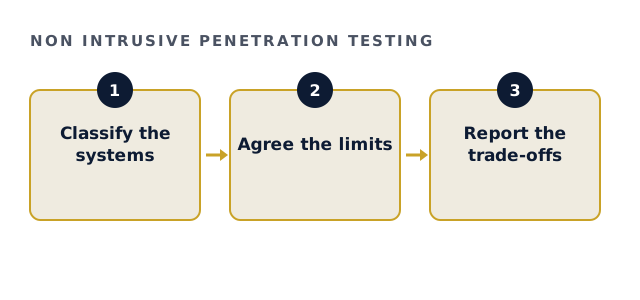
When non intrusive penetration testing makes sense
Some systems cannot risk disruption. For example, production systems with no maintenance window, or legacy equipment that behaves unpredictably. Therefore the rules of engagement restrict what testers may do.
Regulated environments sometimes ask for this approach first. Also, it can precede a deeper test in a staging copy.
What non intrusive penetration testing allows
The line is drawn in writing. However, the exact limits depend on the system.
| Usually allowed | Usually excluded |
|---|---|
| Configuration review | Actions that change data |
| Authenticated inspection | Load or stress activity |
| Careful verification of findings | Exploits with crash risk |
Non intrusive penetration testing readiness check
Tick what is decided.
Your result appears here as you tick, so you can see what is still open.
The trade-off in non intrusive penetration testing
Safety has a cost. Because testers stop before full exploitation, some findings remain likely rather than proven. As a result, the report states confidence for each finding.
- Lower risk to availability
- Less proof of real impact
- More reliance on configuration evidence
- Often paired with deeper staging tests
Rules of engagement
Write the limits into the rules of engagement. Also agree a stop procedure and a contact who can halt testing at once.
In addition, NIST SP 800-115 discusses planning tests to manage operational risk. The guide is at NIST SP 800-115.
How Certus works
Every engagement agrees its limits in writing before testing starts. Full engagements usually settle between $35,000 and $120,000, and the floor is $25,000. The bounded Security Posture Assessment starts at $4,500. Its fee is credited in full against a full engagement commissioned within ninety days.
Also revisit the limits each year. Because systems are upgraded, a fragile system today may tolerate deeper testing later. So the approach should evolve with the estate.
Non intrusive penetration testing questions
Is non intrusive penetration testing a real penetration test?
Yes, with limits. It proves less, but it keeps fragile systems safe.
When is non intrusive penetration testing the right choice?
For critical or fragile systems that cannot risk disruption.
Can non intrusive penetration testing satisfy auditors?
Often, if the limits and their reasons are documented.
Can we go deeper later?
Yes, often in a staging copy of the system.
Related guides
Scope non intrusive penetration testing
Tell us which systems are fragile and why. We return a written scope with clear limits and a fixed fee. Nothing is tested before the owner signs.
Request a written scope