Standards note
NIST CSF penetration testing: where testing fits the framework
NIST CSF penetration testing links technical testing to the Cybersecurity Framework. So results inform your risk picture and your target profile, rather than sitting in a drawer.
- Written scope and rules of engagement
- PTES, OWASP and NIST SP 800-115
- Nothing retained after close
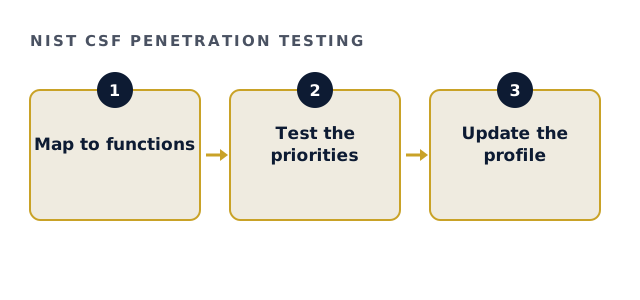
How NIST CSF penetration testing fits the framework
The framework organises outcomes into six functions: Govern, Identify, Protect, Detect, Respond and Recover. However, it does not prescribe a specific test. Therefore penetration testing serves as evidence for several outcomes.
| Function | How testing helps |
|---|---|
| Identify | Reveals real vulnerabilities and risk |
| Protect | Shows whether safeguards hold |
| Detect | Checks whether activity is noticed |
| Respond | Exercises the response process |
Scoping NIST CSF penetration testing
Start from your target profile. So testing focuses on the outcomes you care about most.
- Critical assets named in your risk assessment
- Protect outcomes you rely on most
- Detection capability, if it is a priority
- Third-party connections
- Recent changes to the environment
NIST CSF penetration testing readiness check
Tick what you can share with the tester.
Your result appears here as you tick, so you can see what is still open.
Turning NIST CSF penetration testing results into progress
Map each finding to a framework outcome. As a result, you can show movement between current and target profiles.
Also, track repeat findings across years. Because the framework encourages continuous improvement, trends matter as much as single results.
Related standards
The framework often sits above more detailed catalogues. For example, NIST SP 800-53 controls and NIST SP 800-115 for testing technique. In addition, the framework itself is described on the NIST Cybersecurity Framework page.
How Certus works
Every engagement names the standards it follows in the written scope. Full engagements usually settle between $35,000 and $120,000, and the floor is $25,000. The bounded Security Posture Assessment starts at $4,500. Its fee is credited in full against a full engagement commissioned within ninety days.
Also share results with the people who own each outcome. So findings turn into actions, rather than reports.
NIST CSF penetration testing questions
Does the framework require NIST CSF penetration testing?
No. It sets outcomes, and testing is one way to evidence them.
Which functions does NIST CSF penetration testing support?
Mainly Identify, Protect, Detect and Respond.
How often should NIST CSF penetration testing run?
As your risk and target profile require, often yearly and after major changes.
Is the framework a compliance badge?
No. It is voluntary guidance for managing risk.
Related guides
Scope NIST CSF penetration testing to your profile
Share your target profile and critical assets. We return a written scope that names each standard, with a fixed fee. Nothing is tested before the owner signs.
Request a written scope